
Climate Change & Defense
Military Practice at the Intersection of Local Livelihoods and State Sovereignty
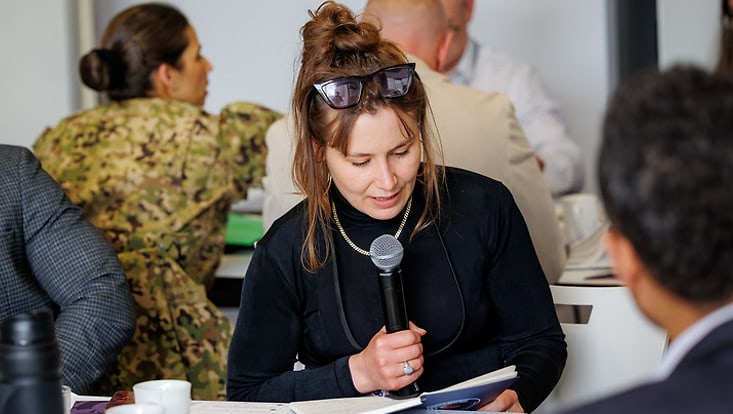
Photo: CCASCOE (Climate Change and Security Centre of Excellence)
Project Team: Svenja McGrath and Benno Fladvad
Funded by German Foundation for Peace Research (DSF)
Project Term: 2026 - 2027
Climate change is transforming not only ecosystems and livelihoods but also the ways states anticipate and govern future risks. This is particularly visible in Arctic territories, where rapid environmental change intersects with growing geopolitical competition and renewed efforts to assert sovereignty across vast territories.
Focusing on the Canadian Arctic, this project, funded by German Foundation for Peace Research, examines how climate-related vulnerabilities are becoming incorporated into priorities and practices of national security and defense. Particular attention is paid to the growing emphasis on ‘deterrence through resilience’ through which civilian infrastructure, local capacities, and community resilience become integrated into national defense considerations, not least due to the recently agreed increased defense spending commitments by NATO Allies. As such, challenges like infrastructure deficits, limited connectivity, and community vulnerability have long shaped life in the North; Increasingly, however, these issues are being framed not only as matters of development or adaptation within civil government spheres but also as central pillars of national sovereignty, operational effectiveness, and deterrence.
Empirically, the research focuses on Joint Task Force North (JTFN) and the 1st Canadian Ranger Patrol Group (1 CRPG), two key components of Canada’s military presence in the North. Through interviews and observations with respective personnel at their headquarters in Yellowknife (NWT), as well as Department of Defense civilian employees, federal and Northwest territories government, Indigenous government representatives, community organizations, and land managers, the project examines how climate-related vulnerabilities and threats are defined from military/ defense and civilian perspectives, where priorities overlap and diverge, how civilian resilience is incorporated into deterrence planning and practices and what the material consequences of this are- both in light of military, civil, and multipurpose infrastructure development as well as the prioritization and marginalization of different security concerns.
By examining these developments, the project addresses a central question of the politics of anticipation: as defense institutions assume a growing role in responding to climate change threats, which definitions of risk and security become authoritative, and with what consequences for human and ecological security? Ultimately, the project argues that climate change is not only generating new security challenges but also transforming the institutions, practices, logics and spatial arrangements through which security is attempted to be provided, reshaping the boundaries between civilian and military domains in the contemporary Arctic and beyond.