
Geology
New theory on the evolution of the iron cycle throughout Earth’s historyHow oxygen found its way into the atmosphere: from rocks on land to the ocean floor
28 July 2026, by Franziska Neigenfind
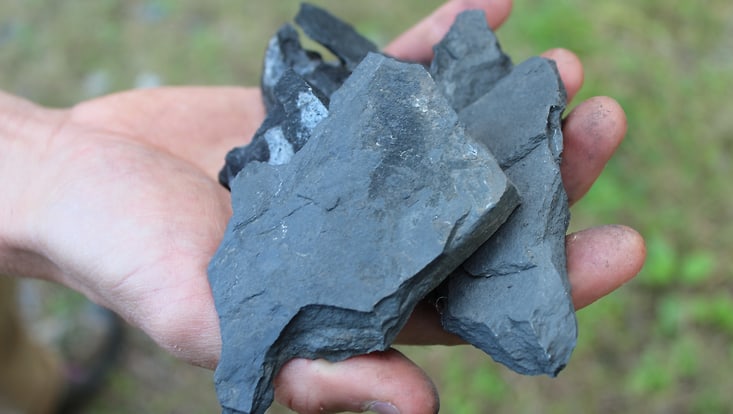
Photo: Florian Scholz
Archive of the iron/oxygen cycle: This black shale from the Late Devonian, a period within the Paleozoic, is a form of sedimentary rock that reflects paleo-environmental conditions.
More iron on the seafloor means less oxygen in the ocean and atmosphere – or at least, that has long been a common assumption in the geosciences. However, a new study led by Prof. Florian Scholz from the University of Hamburg’s Earth and Society Research Hub (ESRAH) turns that idea on its head: in a key phase of our planet’s history, iron and oxygen concentrations rose simultaneously. The key to understanding this lies not in the ocean, but on land – in the weathering of rocks and the spreading of the first land-based plants.
For many years, reactive iron in ocean sediments – that is, iron compounds that participate in biogeochemical processes in marine sediments – was considered to be an indicator of the oxygen content of past oceans: the less oxygen there was, the more reactive iron. But the new data paints a different picture.
The researchers analyzed recent sediment and soil samples, as well as geochemical data from river sediments, and compared them with sedimentary rock samples from various periods in earth history. In the process, they discovered a remarkable pattern: for an incredibly long time – from roughly 1.2 billion years ago to 500 million years ago – seafloor sediments contained very little reactive iron. In the subsequent Paleozoic era, i.e. from roughly 500 million to 300 million years ago, concentrations rose substantially. In the last 65 million years, they have declined again.
“This temporal pattern can’t be reconciled with the previous assumptions. Further, it can’t be explained by changes in the ocean’s redox conditions, that is, by fluctuations in the oxygen and hydrogen sulfide concentrations in seawater,” says geologist and biogeochemist Prof. Florian Scholz. “Rather, our findings indicate that above all, the weathering of rocks on land and the tectonically driven transport of solids into the oceans are what determine how much reactive iron finds its way into ocean sediments to begin with.”
When ferrous silicate minerals on land weather – i.e., when they are broken down by the effects of water, air, and chemical reactions – minerals known as iron oxides are produced. Rivers transport these minerals to the oceans, where they accumulate on the seafloor. Once there, they can transform into pyrite, an iron sulfide mineral, or bond with organic material. As both processes release oxygen, they determine how much oxygen accumulates in the ocean and atmosphere over the span of entire geological periods.
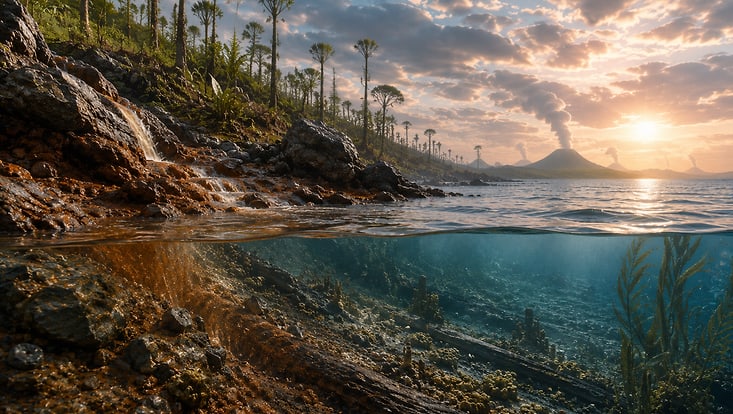
Illustration of an ancient coastal landscape highlighting the role of rock weathering and iron transport (AI-generated).
Particularly striking: the significant rise in iron compounds during the Paleozoic coincided with two key developments – the initial expansion of plants on the continents, and a pronounced rise in atmospheric oxygen. Plants and higher oxygen concentrations accelerate the chemical weathering of soils. As a result, more iron is transported to the ocean, more pyrite is formed – and, over time, the atmosphere’s oxygen balance is influenced further. As such, the study shows that Earth’s iron cycle is closely linked to the evolution of the climate, the land surface, and life.
Publication
Scholz F, Doetterl S, Hardisty DS (2026): The evolution of the Earth’s surface iron cycle, PNAS, doi: 10.1073/pnas.2608784123
Contact
Prof. Florian Scholz
University of Hamburg
Earth and Society Research Hub (ESRAH)
Tel.: +49 40 2395-27062
Email: florian.scholz@uni-hamburg.de

