Soil Science
Nodule Senescence: A Key Process Shaping Biogeochemical Dynamics in Legume Rhizospheres
28 November 2025

Photo: UHH/IfB/E. Albrecht
Root system of a cowpea plant shown at three developmental stages: initial nodulation, peak nodulation, and early nodule senescence.
Elisa Albrecht and Joscha Becker from the Soil Science, University of Hamburg, and Maire Holz from the Leibniz Centre for Agricultural Landscape Research (ZALF), Müncheberg, recently published their study „Spatio-temporal distribution of enzyme activities in cowpea rhizosphere – the role of plant growth stages and nodule senescence“ in Soil Biology and Biochemistry. The work investigates how the aging of nitrogen-fixing nodules affects soil carbon and nitrogen cycling in cowpea grown on contrasting sandy soils from Northern Namibia.
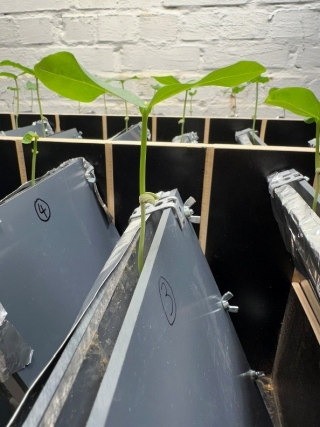
Using a rhizobox experiment and in-situ zymography across early vegetative, flowering, and maturity stages, the team assessed key C- and N-cycling enzymes and tracked changes in soil biochemical properties. Enzyme activities at root and nodule surfaces remained relatively stable throughout plant development, whereas activities in the bulk soil, particularly β-glucosidase and chitinase, markedly increased toward maturity. The effect was strongest in sandy soils, where nodule senescence triggered significant enzyme activity increases, indicating enhanced organic matter decomposition and nutrient release.
These findings highlight nodule senescence as an important, yet underappreciated, driver of soil biochemical dynamics and suggest new opportunities for managing soil fertility in low-nutrient, semi-arid environments.
More on the related Project: