Soil Science
Hidden phosphorus recycling supports Amazon forest growth under rising CO₂
18 September 2026, by Lin Yu
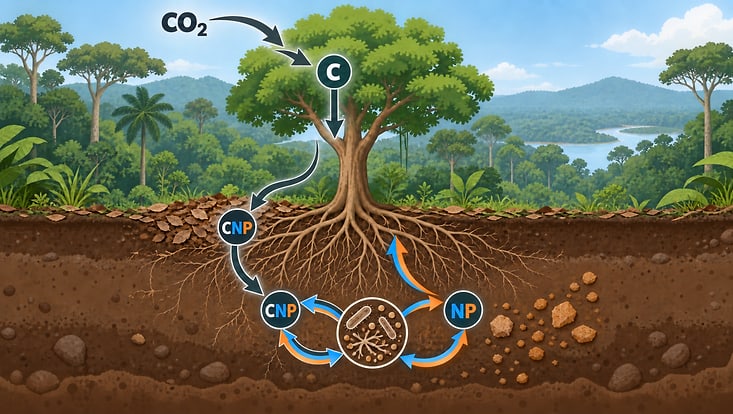
Photo: Lin Yu using the generative AI GPT-6 Astra
Simplified schematic of microbially regulated ecosystem C–N–P cycling
A new study published in Global Change Biology reveals how belowground phosphorus recycling may help Amazon forests sustain growth under rising atmospheric CO₂—while potentially increasing their vulnerability to future climate disturbances.
The researchers simulated carbon and phosphorus cycling across Amazonian forests with contrasting soil phosphorus availability. They found that forests growing on phosphorus-poor soils increasingly depend on microorganisms to release phosphorus from organic matter. This intensified recycling supports plant growth under elevated CO₂ but gradually depletes slowly cycling soil phosphorus pools. Consequently, the continued carbon uptake of these forests may depend on recycling processes that could be disrupted by drought and other climate extremes.
Dr Lin Yu from the Working Group Dynamics of Soil Processes contributed to the development of the research concept and the study methodology. He developed the microbial-explicit Jena Soil Model (JSM), which represents the coupled cycling of carbon, nitrogen and phosphorus among soil organic matter and microorganisms. He later coupled JSM to the QUINCY land model, enabling the simulation of plant–soil–microbe interactions within ecosystems. This process-based modelling framework made it possible to identify the important role of microbial phosphorus recycling and assess how it changes along the Amazon soil phosphorus gradient and under increasing CO₂.
The study highlights the need to represent soil microorganisms and phosphorus cycling more explicitly in land and Earth system models to improve projections of the future Amazon carbon sink.