• Zur Metanavigation
  • Zur Hauptnavigation
  • Zur Suche
  • Zum Inhalt
  • Zur Subnavigation
  • Zum Seitenfuß
  • University of Hamburg
  • For journalists
  • Staff Service Portal0
  • STiNE
https://www.kus.uni-hamburg.de/aktuelles.json?recentnews=true
  • Institutions and target groups
    • Einrichtungen
      • Faculties

        • Faculty of Law
        • Faculty of Business, Economics and Social Sciences
        • Faculty of Medicine
        • Faculty of Education
        • Faculty of Humanities
        • Faculty of Mathematics, Informatics and Natural Sciences
        • Faculty of Psychology and Human Movement Science
        • University of Hamburg Business School
      • Services

        • Study Information Net STiNE
        • Surfmail
        • Exchange
        • Staff Service Portal
        • Learning Platforms
        • Katalogplus – Catalogue of Hamburg Libraries
        • SharePoint
      • Student facilities and services

        • Campus Center
        • Career Center
        • PIASTA
        • AStA (student council)
        • University Sports
        • University Music
        • Family Office
        • University Language Center
        • General Languages
        • Office of Affairs for Students with Disabilities or Chronic Diseases
        • Departmental libraries
        • Healthy Campus
      • Further facilities and services

        • The Cluster of Excellence CLICCS
        • The Cluster of Excellence CUI
        • The Cluster of Excellence Quantum Universe
        • The Cluster of Excellence Understanding Written Artefacts
        • Hamburg Research Academy
        • Pier Plus
        • Hamburg Center for University Teaching and Learning (HUL)
        • Hub for Crossdisciplinary Learning (HCL)
        • CEN
        • Museums and collections
        • University Archives (in German)
        • Regional Computing Center (RRZ)
        • University Administration
        • Knowledge Exchange Agency
        • The Unikontor Shop (in German)
    • Target groups

      • Prospective students
      • Students
      • International prospective students
      • Young researchers
      • Researchers
      • Instructors
      • Staff
      • Prospective continuing education students
      • Alumni
      • Journalists
      • Refugees (in German only)
    Close
  • Language
    • English
    • Deutsch
  • /en/geophysik/sitemap.json
University of Hamburg - to research, to teach, to educate and form, to homepage
Institute of Geophysics
  • About the Institute
    • What is Geophysics?
    • News
    • Directions
    • Staff
    • Equal Opportunities
  • Studies
    • B.Sc. Earth System Physics
    • BSc Geophysics/Ozeanography
    • MSc Geophysics
    • Student Representatives
    • Teaching staff
    • Schedule of Classes
    • FAQ
  • Research
    • Machine learning methods
    • Marine Geophysics
    • Seismology
    • Physics of Volcanoes
    • Applied Seismics
    • Equipment at the Institute of Geophysics
    • Publications
  • People
  • Service
    • Library (BIS)
    • CEN-IT Helpdesk
    • International
  • Contact

Photo: R. Singh

  1. UHH
  2. MIN
  3. Department of Earth System Sciences
  4. Geophysics
  5. Research
  6. Machine learning methods

Machine learning methods in Geophysics

The research of the working group "Machine Learning Methods in Geophysics" deals with the application of machine learning algorithms to various geophysical, mainly seismological, problems.

One of the biggest scientific challenges in the field of geophysics is the extraction of relevant information from the constantly growing amount of collected data. To tackle this problem, the "Machine Learning in Geophysics" working group analyzes geophysical data sets using probabilistic, data-driven approaches. On the one hand, this enables us to better understand the inherent structure of the data and, on the other, it helps us to evaluate large data sets quickly and objectively.

The data sets we deal with in the working group are mainly seismological signals. We automatically evaluate these, for example, with regard to the various signal sources that occur in them, such as earthquakes, landslides or even icequakes. In addition, we try to find correlations between different observations in order to estimate interesting parameters, such as the expected ground movement in the event of a certain excitation or the driving factors for the occurrence of an icequake.

If you would like to learn more about the research of the working group or about possible topics for Bachelor and Master projects, please contact Prof. Dr. Conny Hammer
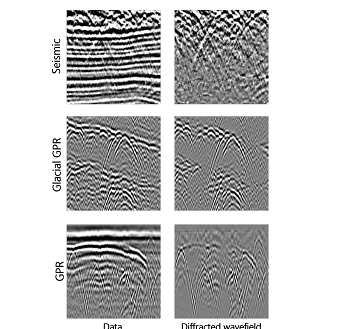
Deep-Learning-Wellenfeldseparation

Deep learning wavefield decomposition for diffraction imaging

Dr. Alexander Bauer

Seismic and electromagnetic waves are not only reflected at large-scale horizons in the subsurface, but they are also scattered or diffracted at small-scale structures. These small-scale structures, such as faults, boulders or water intrusions in glaciers are crucial for the characterization of the subsurface. The separation of the often faint diffraced wavefield is therefore a key challenge in subsurface imaging. We utilize methods of machine learning for the separation of the diffracted wavefield in seismic and ground-penetrating-radar data.
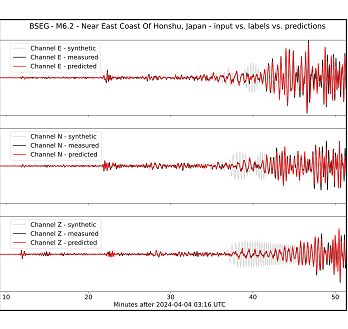
Deep-Learning-Vorhersage von Erdbebenwellenfeldern

Deep learning prediction of earthquake wavefields

Dr. Alexander Bauer

The seismic wavefield that is excited by large earthquakes can be measured worldwide. A detailed knowledge of this wavefield is crucial for high-precision measurements that are carried out for instance in the field of particle physics. However, the regional distribution of seismological stations is often relatively sparse, particularly in regions with low seismic hazard such as Northern Germany. Based on synthetic earthquake waveforms, which can be computed for arbitrary points on the Earth's surface but rely on a relatively simple Earth model we utilize methods of machine learning to predict the seismic wavefield also at points, where no measurements are available.
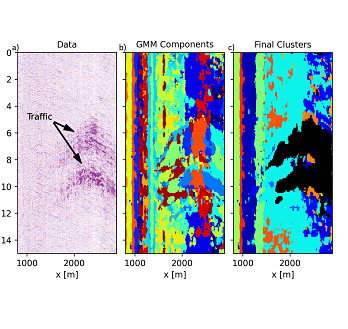
Machine Learning

Clustering of Large Distributed Acoustic Sensing Datasets

Oliver Bölt

Distributed Acoustic Sensing (DAS) turns an optical fiber into a strainmeter by measuring backscattered light inside the fiber. It provides high-resolution seismic data with typical sampling frequencies in the order of 1 kHz and spatial sampling intervals of a few meters. The optical fiber can be several kilometers long and continuous measurements can be carried out over weeks, months or years. This can easily result in several terabytes of data per day, making it very challenging to obtain a good overview of what types of seismic signals the data contains.

Our aim is to cluster large DAS datasets in order to automatically detect and classify different types of seismic signals.
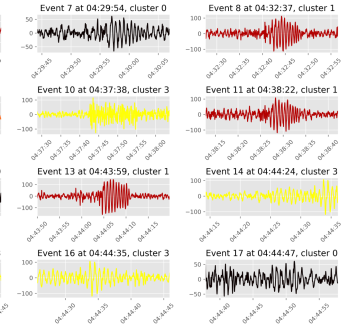
Icequake Types

Identifying and Monitoring Different Types of Icequakes in Antarctica

Antonia Kiel

A multitude of physical processes occurring within the ice of Antarctica give cause for the ice to vibrate. This study aims to identify the various seismic patterns generated within the ice and to relate them to potential processes. Furthermore, the objective is to monitor the occurrence of these processes over the last 20 years in order to gain insight into the influence of climate change on ice dynamics in Antarctica.

  • Research

  • Machine learning methods
    • Team
  • Marine Geophysics
  • Seismology
  • Physics of Volcanoes
  • Applied Seismics
  • Equipment at the Institute of Geophysics
  • Publications

Last update: 14 June 2024

  • Feedback
  • Legal notice
  • Privacy statement
  • Accessibility
  • Site map

University of Hamburg

Innovating and Cooperating for a Sustainable Future in a Digital Age

  • Follow us on Instagram.
  • Follow us on Facebook.
  • Connect with us on LinkedIn.
  • Follow us on Mastodon.
  • Follow us on Bluesky.
  • Subscribe to our channel on YouTube.
    • Studies
    • Prospective students
    • Continuing education
    • Research
    • Teaching at UHH
    • Doctoral studies
    • Job opportunities
    • Knowledge exchange
    • University
    • Excellence
    • Faculties
    • Alumni
    • Contact
    • Campus Navigator
    • UHHApp
    • Emergencies, safety and security
    • Antidiscrimination
Go to family-friendly higher education institution audit
Go to internationalisation re-audit
Go to the Sustainability Audit page
Go to Diversity Audit
Go to System accreditation

© 2026 University of Hamburg. All rights reserved