
Institute of Geophysics
Lake Ice as a Key to Understanding ClimateInternational Field Campaign in Finland with participation from the University of Hamburg
22 May 2026
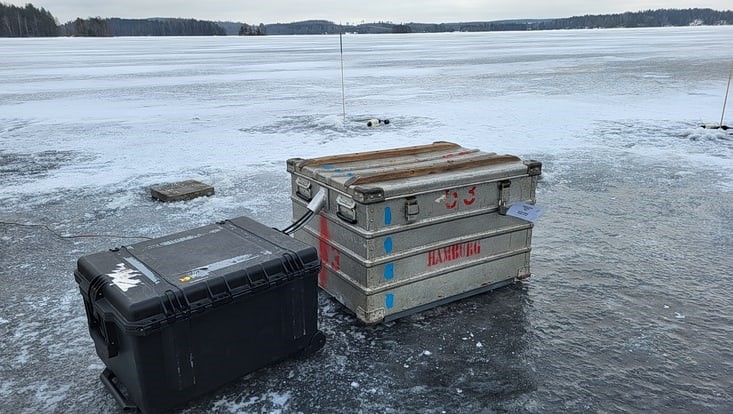
Photo: L. Weißgräber
Rotational sensor and peripheral equipment deployed in a protective housing on the lake
How can environmental processes in frozen lakes be made visible – and what role do they play in the global climate? These questions were at the core of the research campaign “DYNALake”, led by the University of Helsinki. During the winter of 2024/2025, researchers investigated the dynamics of lake ice and its connection to greenhouse gas emissions at Lake Pääjärvi in southern Finland. The University of Hamburg supported the project with specialized instrumentation and technical expertise.
The expedition was accompanied by a documentary film that makes both the fieldwork and the underlying scientific questions accessible to a broader audience.
Documentary film: https://www.youtube.com/watch?v=KPWA8vkfZjc
Environmental seismology: new perspectives on near-surface processes
At the heart of the project lies a relatively young research field: environmental seismology. Unlike classical seismology, which primarily focuses on earthquakes and deep Earth structures, it uses elastic waves to investigate processes close to the Earth’s surface.
“With this documentary, we aim to make environmental seismology more widely known and demonstrate how near-surface processes can be studied at high resolution using seismic methods,” explains Gregor Hillers, project leader of DYNALake.
At Lake Pääjärvi, a range of measurement techniques were combined, including passive seismic methods, ground-penetrating radar, acoustic measurements, and underwater echo sounding. In addition, sediment cores were collected and water samples were analyzed chemically.
Focus on methane emissions from lakes
A key objective of the project is to better quantify the release of methane (CH₄) from lakes. Methane is a colorless and odorless greenhouse gas that contributes significantly to global warming. Its atmospheric concentration today is about 2.5 times higher than in pre-industrial times.
A substantial share of global methane emissions originates from aquatic systems. Of particular importance are gas bubbles rising from sediments at the lake bottom – a process known as “ebullition”. However, these emissions are highly variable in space and time and remain difficult to measure reliably.
This is where DYNALake comes in: by combining seismic and interdisciplinary measurement approaches, the project aims to develop new methods to better detect and understand these processes.
Contribution of the University of Hamburg: high-precision rotational seismology
For the seismic investigations, the University of Hamburg provided a specialized sensor: the BlueSeis-3A.
This rotational seismometer enables the direct measurement of rotational components of seismic waves in addition to conventional ground motion. These additional observations provide valuable insights into the mechanical properties of the subsurface – in particular the structure and dynamics of the lake ice.
The sensor is based on fiber-optic gyroscope technology and is characterized by high sensitivity, broad bandwidth, and very low self-noise. This allows even the smallest motions to be detected with high precision.
Lasse Weißgräber from the University of Hamburg accompanied the field campaign on site and was responsible for installing the system – a demanding task under the extreme conditions of a frozen lake.
In addition to the University of Hamburg and the University of Helsinki, several other partners were involved, including Stockholm University, ETH Zurich, Université Grenoble Alpes, and the Geological Survey of Denmark and Greenland.
This close collaboration enables the integration of diverse scientific approaches and the comprehensive investigation of complex environmental processes.
Science on film
The field campaign was accompanied by a documentary film that documents the work of the researchers in the field. The film “Lake Ice as an Indicator of Environmental Dynamics” provides insights into the methods, challenges, and goals of environmental seismology and shows how international teams work together to address key questions in climate research.
Outlook
The analysis of the extensive datasets will continue over the coming years. The goal is to improve the understanding of physical processes in lake ice and to develop new methods for quantifying methane emissions from lakes.
The results may help reduce uncertainties in climate models and improve the understanding of the role of aquatic systems in the global carbon cycle.
links
https://www.helsinki.fi/en/researchgr...
https://www.helsinki.fi/en/institute-...
https://www.helsinki.fi/en/researchgr..
https://www.helsinki.fi/en/research-s...

